
One might describe the ocean as a "precious jewel", or perhaps a "treasure box of life" but less metaphorically, our ocean is actually home to extractable deposits of silver and gold (copper, zinc, and lead too). So... what shall we do with this wealth?
The Canadian (and BC-based) company, Nautilus Minerals has emerged as a major player in the exploration of deep-sea mining possibilities, most notably through its activities related to mining the waters off the coast of Papua New Guinea. Nautilus is also interested in mining areas offshore from Vancouver.
Last week, Wood's Hole Oceanographic Institution hosted a Deep-Sea Mining Workshop to promote interdisciplinary and international collaboration on deep sea mining issues. While there was only modest media coverage of this 100-person, invite-only event; deep-sea mining is becoming a hotly-contested issue for many people who are concerned about the health of the oceans. Rick Macpherson, a scientist based in San Francisco, offers some interesting reflections on the workshop.
Sea floor mining on a large scale has never been attempted before, so we can't fully understand the environmental implications of such a practice. What we do know is that deep sea systems are vulnerable and are often slow to recover from damage. One of my specific concerns is that there are many different kinds of marine life that exist near the hydrothermal vents and if we are not careful, deep sea mining could alter or harm the ecosystem upon which these creatures depend.
What are your thoughts on deep-sea mining? How would you feel if deep-sea mining occurred on the Pacific coast of Canada?
Thursday, April 9, 2009


Wednesday, April 8, 2009
A Stain Upon the Sea - Salmon Farming on the West Coast

This book, winner of the 2005 Roderick Haig-Brown BC Book Prize is a must read for anyone concerned about the controversies surrounding farmed fish on the west coast.
Stephen Hume, Alexandra Morton, Betty C. Keller, Rosella M. Leslie, Otto Langer, and Don Staniford all weigh in on the numerous threats posed by salmon farming to our wild Pacific salmon.
Stephen Hume, an award winning journalist, starts off the first chapter describing how he first heard about rumours that something dreadful was happening in the Broughton Archipelago where pink salmon runs were simply not showing up and that fish farms and sea lice congregating around fish farms might be playing a crucial role in diminishing the ability of wild salmon smolts to survive. Hume describes the beginnings of his research,“As I began fishing for answers, I found myself on a journey not unlike that of the salmon themselves, a journey that began on the spawning beds of little-known BC rivers, took me halfway around the world and brought me back, eventually, to the river where my own memories began.”
Hume eloquently describes the concerns of Heiltsuk and Nuxalk elders from the central coast and their zero tolerance toward open net cage salmon farms in their traditional territories. He interviews many of the people involved not only in the fish farm industry itself but scientists, environmentalists and crusaders for a more sustainable aquaculture industry. Traveling to
Staniford goes on to say that salmon farmer’s response to the disease and parasite problem has typically not been to reduce stocking densities, scale back on production or leave the sea bed fallow so it can recover. Instead they have resorted to an ever more powerful arsenal of dangerous and hazardous weapons, pressuring agricultural chemical companies to develop novel treatments for use in aquaculture.
I must confess that his descriptions of the chemical soup prevalent in net cage salmon farming was hard to digest and so I moved on to the next essay somewhat unnerved by the long list of toxic chemicals used with little or no regard to their effect on the environment surrounding the fish farms.
One commercial fisherman, after the collapse of the mainland inlet pink salmon runs in 2002, was quoted as saying, “I guess the scary thing is that Alex Morton predicted this would happen back in 2000. And she was right. Now she’s predicting extinction. I don’t think we can afford to wait to see if she’s right again.”
The book starts with an introduction by David Suzuki, a preface by Terry Glavin and concludes with a seven-point action plan to resolve the hazards of salmon farming.
After reading this book, and I know one of the authors as well as a number of the people mentioned in Stephen Hume’s essay, it is has become quite clear to me that the time to transition to closed containment salmon aquaculture here on the coast is long overdue.
Launch of the Go Wild Kayak Expedition
On Saturday, May 2nd at 10 am, the Go Wild Kayak Expedition will launch from the shores of Gig Harbor, Washington. People in the area are encouraged to rent a kayak (discounts are available) and paddle with Phil and Apryle for the first few miles of their journey. Each paddler will be identified with an orange balloon. Visit the Go Wild website for more information about the launch.
The Go Wild team will also be stopping in Sointula during our World Oceans Day Festival on June 6th to talk about the expedition and show us some pictures from their journey. Stay tuned for more information about this in the weeks to come!
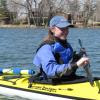
The Go Wild team will also be stopping in Sointula during our World Oceans Day Festival on June 6th to talk about the expedition and show us some pictures from their journey. Stay tuned for more information about this in the weeks to come!
Tuesday, April 7, 2009
Monday, April 6, 2009
Jane Lubchenco Approved by US Senate
 Update: As we wrote in an earlier post, President Barack Obama appointed Dr. Jane Lubchenco, an accomplished scientist and an outspoken climate activist, to head the National Oceanic and Atmospheric Administration (NOAA) in the United States. This is a great move towards healthy oceans that was applauded around the world. About a week ago, the US Senate approved Dr. Lubchenco's appointment without objection. Here is a New York Times Article that ran last week about Dr. Lubchenco and all the great work that she has done.
Thursday, April 2, 2009
An Interesting MPA Mapping Tool from our Neighbours to the South
I have just come across the MarineMap Decision Support Tool. This interactive site was set up to assist Californian stakeholders in the design of Marine Protected Areas by mapping oceanographic, biological, geological, chemical, and human dimensions of the ocean and coastal areas. This MarineMap tool is a great way for a broad spectrum of stakeholders to understand the diverse range of factors that decision-makers must take into consideration when establishing a network of MPAs. California has kept its promise to establish a network of MPAs, as legislated by the State in the 1999 Marine Life Protection Act.
 I hope that in the future, the PNCIMA process will also allow for the establishment of a network of MPAs in British Columbia, and I see the British Columbia Marine Conservation Analysis as a very useful source of information for this and for other marine planning decisions on our coast.
The yellow areas in the map to the right identify the top 50 locations of high conservation value identified by Living Ocean Society’s Conservation Utility Analysis (CUA), completed in 2004. The lessons learned in the CUA are being incorporated into the new and improved BCMCA project.
 I hope that in the future, the PNCIMA process will also allow for the establishment of a network of MPAs in British Columbia, and I see the British Columbia Marine Conservation Analysis as a very useful source of information for this and for other marine planning decisions on our coast.
The yellow areas in the map to the right identify the top 50 locations of high conservation value identified by Living Ocean Society’s Conservation Utility Analysis (CUA), completed in 2004. The lessons learned in the CUA are being incorporated into the new and improved BCMCA project.
Wednesday, April 1, 2009
WWF Releases Results of a Planning Participation Study
Last week, the World Wildlife Fund released the results from a marine planning / community preparedness survey it took last summer and fall in the North Coast communities of Prince Rupert, Terrace, Haida Gwaii and Kitimat. While this survey was not taken in our Northern Vancouver Island communities, the questions that were asked in the survey are very relevant to our experience on the coast as well. The survey results showed that people on the coast usually have very direct linkages to the ocean environment:
"Nearly half of all respondents (48 per cent) said they depend on the marine environment for work while 53 per cent indicated that the ocean is a significant source of food and 65 per cent indicated that it is an important recreation resource. A further 58 per cent said that the marine environment plays a vital role in their cultural traditions and even more so (67 per cent) in family traditions." 1
Another interesting finding from this research is that while 65% of the respondents indicated that they have been involved in a marine planning or consultation processes in the past, only a quarter of them agreed that this involvement had been a positive experience.
 While Mike Ambach of WWF in Prince Rupert says that this survey was not specifically designed to fit in with PNCIMA, I do hope that WWF will be able to find some synergy between the two. Most of the concerns brought up by coastal residents in this survey, such as declining fish stocks, climate change, and poor fisheries management could be addressed with an inclusive PNCIMA process.
Have you taken part in marine planning consultations before? Was it a positive experience? What are your suggestions for Fisheries and Oceans Canada as it begins the PNCIMA consultation and planning process?
"Nearly half of all respondents (48 per cent) said they depend on the marine environment for work while 53 per cent indicated that the ocean is a significant source of food and 65 per cent indicated that it is an important recreation resource. A further 58 per cent said that the marine environment plays a vital role in their cultural traditions and even more so (67 per cent) in family traditions." 1
Another interesting finding from this research is that while 65% of the respondents indicated that they have been involved in a marine planning or consultation processes in the past, only a quarter of them agreed that this involvement had been a positive experience.
 While Mike Ambach of WWF in Prince Rupert says that this survey was not specifically designed to fit in with PNCIMA, I do hope that WWF will be able to find some synergy between the two. Most of the concerns brought up by coastal residents in this survey, such as declining fish stocks, climate change, and poor fisheries management could be addressed with an inclusive PNCIMA process.
Have you taken part in marine planning consultations before? Was it a positive experience? What are your suggestions for Fisheries and Oceans Canada as it begins the PNCIMA consultation and planning process?
Subscribe to:
Posts (Atom)


 Posts
Posts

